In modern textile dyeing, maintaining fabric quality while improving production efficiency is a major challenge for manufacturers, especially when processing elastic fabrics such as Nylon/Spandex and Cotton/Spandex. These materials are widely used in sportswear, underwear, stretch garments, casual clothing, and other textile applications where elasticity, softness, and surface appearance are essential. However, during high-temperature dyeing and fabric circulation, improper tension, uneven fabric movement, and prolonged compression can lead to crease marks, uneven dyeing, and surface defects. Selecting a suitable Ultra-low Liquor Flow Dyeing Machine and optimizing the fabric transportation process are therefore important for achieving consistent dyeing results.
Nylon/Spandex and Cotton/Spandex fabrics have different fiber characteristics, but both require careful mechanical handling during wet processing. Spandex provides elasticity and stretch recovery, while nylon and cotton contribute different surface, strength, and moisture-related properties. During dyeing, repeated fabric circulation, changes in tension, and compression inside the machine may cause local deformation. If the fabric remains compressed in one position for too long, crease marks can develop and may become more difficult to remove during subsequent finishing.
Several factors can contribute to fabric creasing. Excessive fabric accumulation inside the main barrel, unstable fabric transportation, unsuitable loading conditions, and inappropriate machine operating parameters can all affect fabric movement. In addition, the fabric's construction, weight, elasticity, and pretreatment condition influence its response to mechanical forces. For this reason, preventing creasing requires more than adjusting dyeing temperature or chemical concentration. The machine structure, fabric circulation system, and process settings must work together.
Stable fabric circulation is one of the most important conditions for reducing crease formation. The fabric should move continuously through the machine without excessive accumulation, twisting, or localized compression. Maintaining suitable fabric speed and transportation tension helps reduce unnecessary mechanical stress, particularly when processing lightweight elastic knits or fabrics with sensitive surfaces.
Nozzle performance and liquor circulation also play important roles. The nozzle guides the interaction between the circulating dye liquor and the moving fabric, while the main pump supplies the circulation flow required by the dyeing system. An appropriate combination of nozzle configuration, pump performance, and fabric speed helps maintain stable processing conditions and supports dyeing uniformity. However, operating parameters should always be selected according to the fabric construction, machine configuration, and specific dyeing recipe rather than simply using the highest available speed or flow rate.
Process control is equally important. Nylon/Spandex and Cotton/Spandex should not automatically share identical dyeing conditions. Their fiber compositions and dyeing requirements differ, so temperature profiles, dye selection, pH conditions, heating rates, and processing times need to be determined according to the material and production requirements. Proper pretreatment and loading practices also help reduce potential fabric deformation before the dyeing cycle begins.
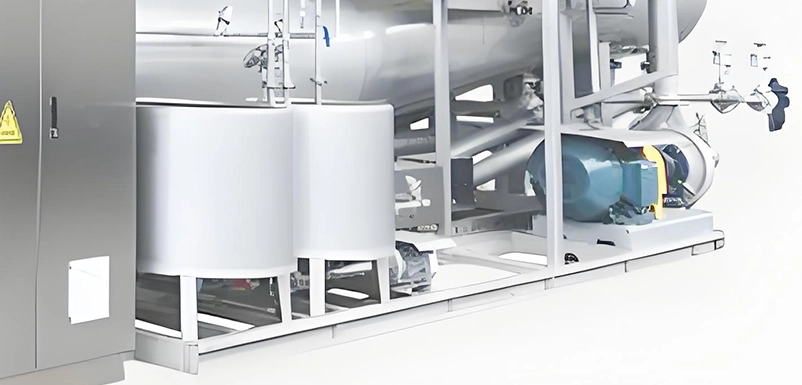
Besides process optimization, the mechanical design of a dyeing machine has a direct influence on fabric transportation and accumulation. For elastic and surface-sensitive fabrics, the internal barrel structure should allow the fabric to move smoothly while avoiding prolonged compression. This is one of the important design considerations behind Yadong's MD Ultra-low Liquor Flow Dyeing Machine.
The MD model adopts a large-diameter single barrel with a double fabric groove design. This configuration is developed for fabrics with specific single-meter length input limitations, helping improve machine utilization compared with conventional single-tube, single-groove arrangements. The two fabric grooves are equipped with independent guide wheel systems, allowing their lifting and transportation processes to operate without mechanical interference. This design supports efficient fabric movement and high-speed operation of the respective fabric paths.
Another important feature is the special stepped main barrel structure. After passing through the tail section, the fabric enters the main barrel and moves through a stacking and creeping process. Compared with prolonged static accumulation, this dynamic movement helps reduce sustained compression on the fabric and addresses crease formation associated with long-term extrusion. It is particularly relevant when processing materials whose surface appearance and dimensional stability are sensitive to mechanical handling.
The machine also uses large-flow nozzles to improve the leveling effect, together with a high-head, high-quality main pump designed to provide stable and reliable operation. These components work as part of the overall fabric and liquor circulation system. When properly matched with the fabric type and dyeing recipe, they help support consistent processing and production efficiency.
Although both materials contain spandex, Nylon/Spandex and Cotton/Spandex have different dyeing characteristics. Nylon/Spandex fabrics are commonly processed with dyeing systems suitable for polyamide fibers. Temperature control, dye compatibility, pH management, and fabric tension are important considerations for maintaining color consistency and elasticity. Excessive mechanical stress or unsuitable processing conditions may also affect the fabric's dimensional stability and surface appearance.
Cotton/Spandex fabrics require attention to the dyeing behavior of cotton and the heat sensitivity of the spandex component. Depending on the fabric composition and selected dyeing process, manufacturers need to balance color development, washing requirements, shrinkage control, and elastic recovery. The process should be designed to meet the requirements of both fiber components instead of focusing only on cotton dye uptake.
For both fabric types, machine selection should be based on actual fabric specifications, including fiber composition, fabric weight, construction, width, elasticity, and batch size. A suitable fabric circulation system combined with a properly developed dyeing recipe can help reduce processing defects and improve finished fabric quality.
When evaluating an Ultra-low Liquor Flow Dyeing Machine, textile manufacturers should consider more than its nominal production capacity. The fabric transportation structure, barrel configuration, guide wheel arrangement, nozzle design, and main pump performance are all relevant to the intended application. These factors determine whether the equipment can accommodate the movement characteristics and processing requirements of different elastic fabrics.
Production capacity and machine configuration should also match the factory's batch sizes and production plans. Yadong's MD series offers four configurations: MD-1(2)-300, MD-1(2)-400, MD-2(4)-600, and MD-2(4)-800, with listed fabric capacities ranging from 150 kg to 800 kg. The maximum operating temperature is 140°C, the maximum pressure is 4 kg/cm², and the listed fabric speed range is 150–600 m/min. Main pump power varies from 30 HP to 75 HP depending on the model.
Before purchasing equipment, manufacturers should also evaluate optional process-control configurations. Depending on production requirements, available options include water and steam flowmeters, proportional heating and cooling devices, proportional dosing devices, fabric length measuring devices, pH control systems, and high-temperature washing systems. Selecting suitable configurations can help improve process management and adapt the equipment to different production needs.
Zhejiang Yadong Machinery Co., Ltd. specializes in the development and manufacture of textile dyeing and finishing equipment. Founded in 2001, the company combines engineering experience, manufacturing capabilities, and production management systems to provide dyeing solutions for textile manufacturers. Its product range includes high-temperature and high-pressure liquid flow dyeing machines as well as ultra-low liquor flow dyeing machines designed for different fabric types and processing requirements.
The Yadong MD Ultra-low Liquor Flow Dyeing Machine is designed for processing Nylon/Spandex, Cotton/Spandex, Polyester/Spandex, T/C, T/R, suede velvet, and super-soft velvet fabrics. Its large-diameter double-groove barrel, stepped main barrel structure, independent guide wheels, large-flow nozzles, and high-head main pump address important requirements in fabric transportation, crease reduction, and dyeing performance. In addition to dyeing, the equipment supports untwisting, preshrinking, reduction, and other processing applications.
For textile manufacturers looking to improve the handling of elastic fabrics and optimize dyeing production, choosing equipment according to fabric characteristics and process requirements is essential. With its MD series design and multiple capacity configurations, Yadong provides an equipment option for factories seeking stable fabric circulation, efficient processing, and improved control over fabric quality.
If you are looking for an Ultra-low Liquor Flow Dyeing Machine for Nylon/Spandex, Cotton/Spandex, or other stretch fabrics, contact Zhejiang Yadong Machinery Co., Ltd. to discuss your fabric specifications, production capacity, and equipment configuration requirements.